

Social Service Department in Community Awareness


Early Marriage Prevention, Dengue Prevention Awareness, Cleaning and Tree Plantation Activities
Social Service Department in Community Awareness on
Early Marriage Prevention,
Dengue Prevention Awareness, Cleaning and Tree Plantation Activities
Under: National Welfare Parishad Fund, Ministry of Social Welfare
Supported by: District
Social Service Office, Khulna
1. Background
Green Resilience and Cooperation
for Ecosystem (GRACE) has received financial support from the District
Social Service Office, Khulna, under the Ministry of Social Welfare,
through the National Welfare Parishad Fund based on GRACE’s project
application submitted in 2024. The initiative aims to contribute to community
well-being through integrated social awareness and environmental actions. This
support will strengthen local engagement in social and environmental protection
by focusing on preventing early marriage, raising dengue awareness, promoting
cleanliness, and fostering tree plantation drives.
2. Funded By
National Welfare Parishad Fund,
Ministry of Social Welfare,
Government of Bangladesh.
3. Implemented by
Green Resilience and
Cooperation for Ecosystem (GRACE)
In collaboration with local youth
groups, community leaders, and volunteers.
4. Implementation Area
Within Khulna District.
(Jalma Union under Botiaghata Upazila and Ward no #31 in KCC)
5. Objective of the events:
- To raise community
awareness and behavioral change against early marriage practices.
- To promote dengue
prevention and hygiene practices through community-based actions.
- To encourage clean and
green environments through cleaning campaigns and tree plantation
activities.
- To promote tree
plantation for improving local biodiversity, reducing heat, and creating
eco-friendly community spaces.
- To enhance civic
responsibility and youth participation in building a healthier, more
resilient community.
6.
Methodology
The project was adopted a community engagement and participatory
approach emphasizing awareness, demonstration, plantation and collective
actions.
Key methods include:
- Organizing courtyard
meetings and school-based awareness sessions.
- Dissemination of IEC
(Information, Education, and Communication) materials such as leaflets,
posters, and banners.
- Mobilizing youth
volunteers and local leaders for cleaning drives and plantation events.
- Conducting public
rallies and street campaigns to disseminate messages on early marriage
prevention and dengue control.
- Partnering with
schools and community groups to ensure sustainability and local ownership
of the activities.
7. Major Activities and
achievements:
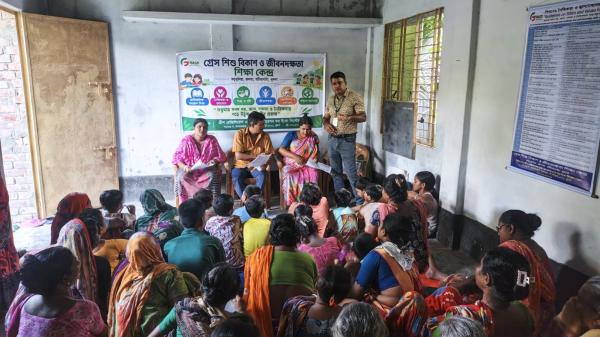
v Early Marriage Prevention Awareness Campaign – KCC, W#31
and Raypara, Jolma, Botiaghata:
To strengthen community awareness
and collective responsibility in preventing early marriage, two awareness
campaigns were organized in Ward number 31 under Khulna City Corporation and Raypara, Jolma under Botiaghata Union. The
campaigns were conducted through rallies and discussion meetings, engaging a
wide range of community members. In total, 150 women, 20 youths and adolescent
girls, and 35 men, including social activists and local leaders, actively
participated.
The sessions focused on key
issues such as the negative impacts of early marriage, its legal and social
consequences, and the government’s prevention mechanisms—including official
communication channels and hotline numbers for immediate action.
To enhance visibility and sustain
community engagement, three billboards were installed in strategic public
locations, and 50 leaflets were displayed across schools, markets, ward
offices, and temples, reinforcing the message that early marriage must be
prevented to ensure a safer and brighter future for girls.
v Cleaning Campaign and Dengue prevention:
A Cleaning Mission for Dengue
Prevention and Promotion of Urban Agricultural Practices for a Healthier
Lifestyle
Unmanaged household waste and
single-use plastics are increasingly affecting both the environment and public
health. Improper waste disposal leads to clogged waterways, soil pollution, and
contributes to the broader impacts of climate change.
In Khulna City, the challenges
have intensified due to rapid population growth and climate-induced migration,
placing immense pressure on the city’s waste management systems. Once-open
fields and private lands have gradually turned into informal dumping grounds
filled with plastic waste, household debris, and hazardous materials. During
the monsoon season, these areas flood easily, spreading contaminants and
creating breeding grounds for mosquitoes responsible for diseases such as
dengue.
In Labanchara Ward No. 31,
particularly around Bandhabazar and Modina Sharak, approximately 600 residents
face such environmental and health risks. Three unused private lands had turned
into waste-filled, stagnant-water sites with no functional drainage system.
To address this growing concern,
on October 10, 2025, the organization Green Resilience and Cooperation for
Ecosystem (GRACE) implemented a one-day cleaning and restoration mission in one
of these high-risk areas. The initiative was supported financially by the
District Social Service Office and the Department of Social Services under the
Ministry of Social Welfare, Government of Bangladesh.
The community-led action focused
on waste removal, area disinfection, and dengue prevention. What was once an
unmanaged dumping site filled with plastic, broken glass, and household waste
has now been cleaned, disinfected, and officially restricted from further
dumping. The site is also being prepared for urban agricultural practices,
promoting healthy lifestyles and sustainable use of urban land.
This initiative has sparked
positive behavioral changes among community members. Households have started
using personal waste bins to manage garbage responsibly, helping to maintain
cleanliness and hygiene in their surroundings.
The transformation of Bandhabazar
stands as a model of community-driven resilience—demonstrating how local
participation can convert neglected spaces into productive, healthy
environments.
The GRACE initiative reaffirms
that sustainable waste management is not merely an environmental obligation but
a collective act of care for people, the planet, and the future. Through
cooperation and awareness, communities can transform waste into resilience and
build a cleaner, greener, and healthier tomorrow.
v Dengue prevention campaign:
Awareness and Outreach
Activities: Dengue Prevention and Early Marriage Prevention Campaign
As part of ongoing efforts to
promote public health and social awareness, two dengue prevention billboards
were installed at strategic locations to maximize visibility and
Alongside this, 50 informative
leaflets were distributed across markets, schools, and other public
spaces, providing essential guidance on preventing dengue and maintaining
hygienic surroundings.
In conjunction with these
awareness materials, interactive discussion sessions were conducted as
part of the Early Marriage Prevention Campaign. A total of 205
participants took part, including women, local representatives,
adolescents, and youth. During these sessions, participants were engaged in
detailed conversations about the negative consequences of early marriage,
preventive measures, and the role of community vigilance in ensuring the
well-being of young girls.
v Tree Plantation:
Tree Plantation Program at Raypara Government Primary
School, Ward #31, Shipyard, Khulna
From 15–17
October 2025, a tree plantation program was successfully implemented at Raypara
Government Primary School, located in Ward #31, Shipyard, Khulna. The activity
followed a systematic process including soil preparation, pit digging, sapling
plantation, and fencing installation.
A total of 16 large (approximately 5-foot-tall)
fruit saplings were planted, consisting of Mango (5), Hog Plum (5),
Olive (2), and Peanut (4) varieties. Each sapling was planted using organic
fertilizer and secured with protective fencing to ensure healthy
growth and safety from livestock or damage.
Around 40 students and teachers actively
participated in the inauguration and plantation process. During the event, Head
Teacher Mrs. Shamima Khatun expressed her appreciation, noting that while
many organizations have conducted tree planting in various areas, GRACE’s
initiative stood out for its use of tall, healthy saplings and strong
fencing structures. She highlighted that, in other cases, trees are often small,
weak, and poorly protected, leading to low survival rates.
The school community expressed sincere gratitude to
GRACE for its well-organized and sustainable effort to promote greenery and
environmental awareness among students.
8. Time Frame
1st to 31st
October 2025 (10-12 Bill board and leaflet display, 15 and 17 rally and
discussion meeting, 15-17 Tree plantation & 10 Cleaning campaign)
9.Major outcomes:
ü Billboards
for Change: Six vibrant billboards—three on dengue prevention and three on
early marriage prevention—now stand tall in public spaces, serving as constant
reminders and learning tools for the community.
ü Leaflets
for Awareness: A total of 100 informative leaflets were distributed across
markets, shops, schools, and other busy areas, reaching hands and hearts with
vital messages on health and social protection.
ü Greening
the Future: In a transformative effort at Raypara Government Primary School, 16
healthy saplings were planted, each secured with sturdy, high-quality
fencing—symbolizing growth, care, and protection for the next generation.
ü Community
Sensitization: Through engaging discussions and interactive sessions, 205
participants—including women, local leaders, students, adolescents, and
youth—were sensitized on the dangers of early marriage and the importance of
dengue prevention, planting seeds of knowledge and responsibility throughout
the community.
11. Conclusion
This initiative embodies GRACE’s
commitment to advancing social welfare, community health, and environmental
sustainability. Supported by the District Social Service Office, Khulna
under the Ministry of Social Welfare, the project will strengthen local
resilience, reduce social vulnerabilities, and promote a cleaner, greener, and
safer environment for all. Through combined awareness and action, the community
will take meaningful steps toward a more equitable and sustainable future.
Annex-I: SSD Agreement


Explore further
Our Partners