

Skill Hands: Fighting Against Poverty for a Sustainable Future

Together, We Can Turn Skills into Sustainable Futures
Background:
Khulna, a southern coastal city of Bangladesh, stands at the frontline of the global climate crisis. Marked as a climate hotspot, the city has become a primary destination for displaced families fleeing cyclones, river erosion, and salinity intrusion. According to national reports, nearly 12% of Khulna’s population are climate migrants, while more than 40% of residents live below the poverty line. The pressure is most visible in the city’s informal settlements: in Khulna’s three largest slums, 49% of dwellers are climate-induced migrants, with certain pockets, such as Ward 31, reaching as high as 70%.
These figures are not just statistics—they reflect thousands of families forced into precarious living conditions, where poverty, food insecurity, and lack of dignified work reinforce a cycle of vulnerability. Families who once depended on farming or fishing now struggle to adapt to urban poverty, with limited access to skills, resources, or income-generating opportunities.
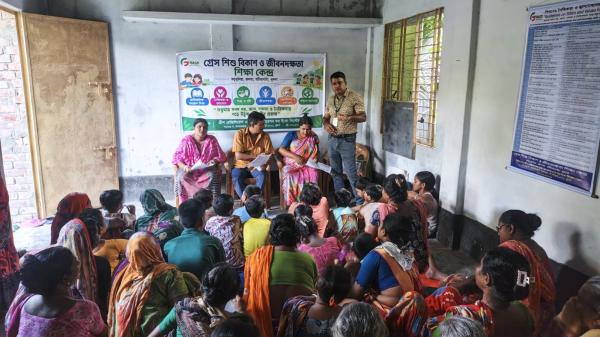
GRACE’s community assessment confirmed this multi-dimensional vulnerability, where the weight of low income and lost livelihoods constrains entire households, particularly women and youth, from building resilient futures. Responding to this urgent need, GRACE has initiated skill development programs tailored for women and young people. By focusing on both traditional livelihoods, such as tailoring, and forward-looking opportunities, such as freelancing, digital skills, and AI, these programs are designed to unlock potential, restore dignity, and transform vulnerability into resilience.
Contribution to SDGs:
The initiative directly contributes to the achievement of multiple Sustainable Development Goals (SDGs) by transforming the lives of climate-affected communities in Khulna. Through skill development for women and youth, the program advances SDG 1 (No Poverty) and SDG 2 (Zero Hunger) by increasing household incomes and strengthening food security. By equipping women with tailoring skills, it promotes SDG 5 (Gender Equality), while youth-focused digital and freelancing training fosters SDG 8 (Decent Work and Economic Growth) and SDG 10 (Reduced Inequalities). Targeting vulnerable slum populations, where up to 70% are climate migrants, the initiative also enhances SDG 11 (Sustainable Cities and Communities) and supports adaptive measures aligned with SDG 13 (Climate Action). Beyond these, improved income opportunities contribute to better health, education, and resilience, reinforcing the broader 2030 Agenda for Sustainable Development.

Interventions
1. Tailoring Training for Women
A three-month tailoring course trained 10 women in cutting, stitching, and garment design. By the end of the training, 8 women successfully graduated, and average monthly incomes increased from BDT 0 to BDT 6,500.
""This training has given me hope. Now I can support my family by stitching clothes at home." — Rexona Begum"
2. Computer, Freelancing & AI Training for Youth
From October to December 2024, GRACE organized a digital skills training program for 10 youth, focusing on MS Office, freelancing, and e-business. With expert facilitation, the training enabled participants to secure online work. Graduates reported an average monthly income of BDT 18,000 through freelancing and digital entrepreneurship.
""This training changed my perspective on earning online. I never thought I could make money just by knowing MS Office and freelancing. Now, I have my first client!" — Md. Mahedi Hasan Saad"

Major Outcomes
• Tailoring: 8 women gained income-generating tailoring skills.
• Digital Skills: 10 youth acquired employable digital skills.
• Average monthly income increased by BDT 6,500 for women and BDT 18,000 for youth.
• Enhanced self-reliance and confidence among participants.

Challenges and Way forward:
Despite the positive outcomes, several challenges remain in sustaining the impact of the program. For women trainees, the limited availability of sewing machines restricts their ability to fully utilize their skills and scale income-generating activities. Similarly, youth face barriers such as a lack of advanced mentorship and reliable internet connectivity, which hinders their competitiveness in the global freelancing market. To address these gaps, the way forward includes providing sewing machines or microloans to tailoring graduates, expanding digital training to incorporate AI, financial literacy, and entrepreneurship, and building mentorship networks and market partnerships at both local and global levels. These steps will ensure long-term sustainability, greater income opportunities, and enhanced resilience for climate-affected communities.

At its core, this initiative is about investing in people—their capacity, creativity, and courage—to ensure that climate migration does not translate into permanent poverty, but rather becomes a stepping stone toward inclusive growth and sustainable futures.

Explore further
Our Partners